What grows from one breath
What collaborating with more than 100 composers taught me about professionalism, AuDHD, safety, and communion
A colleague recently asked me for thoughts and resources on professionalism for composers (broadly defined) for their university module. I started mentally making the obvious list: clear materials, preparation, communication, rehearsal etiquette, fees, respecting people's time, knowing what you are asking somebody to do.
I was also bored almost immediately. All of those things matter, and there is already excellent writing about them. Then I realised that for almost ten years I have been conducting a rather peculiar experiment in this myself.
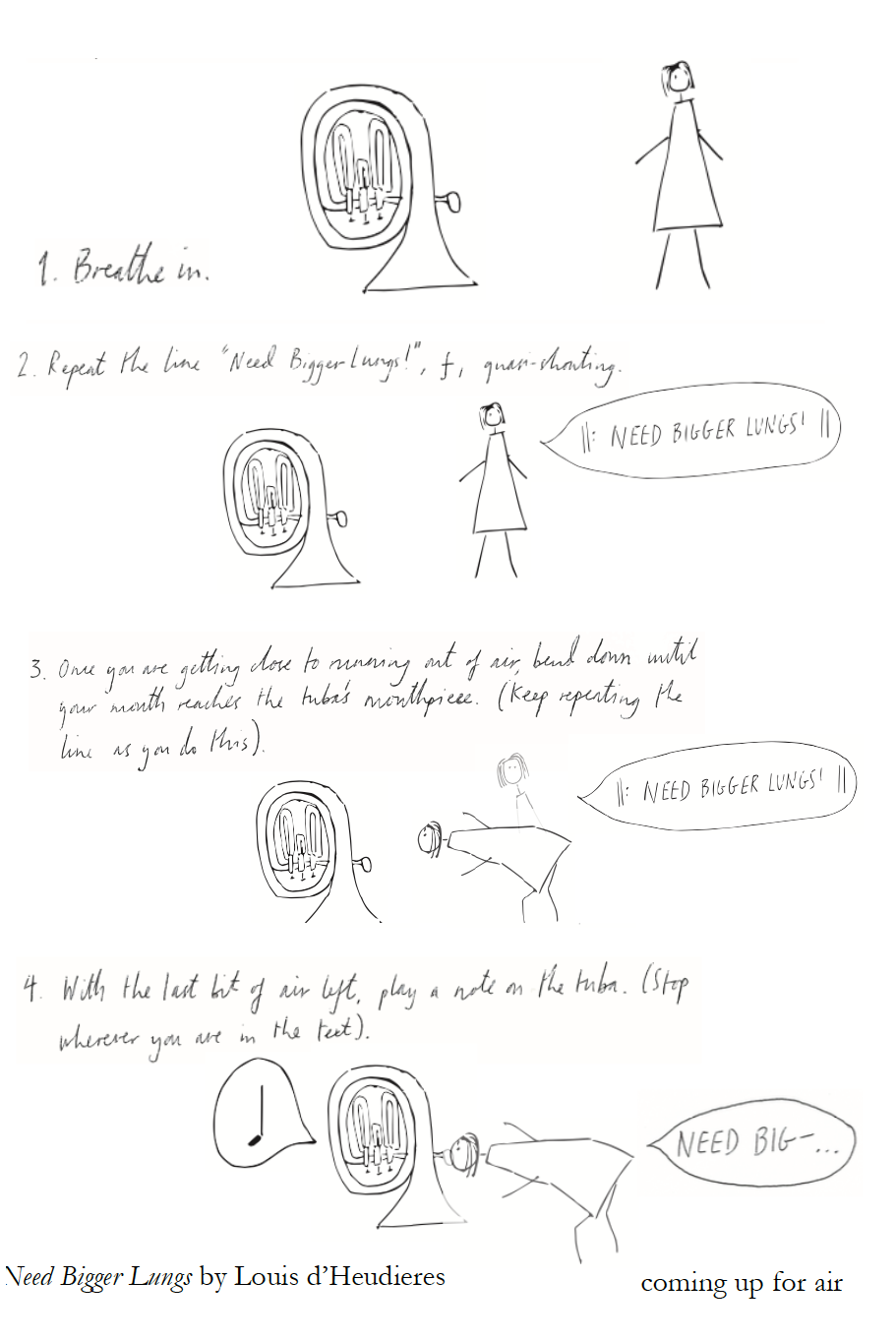
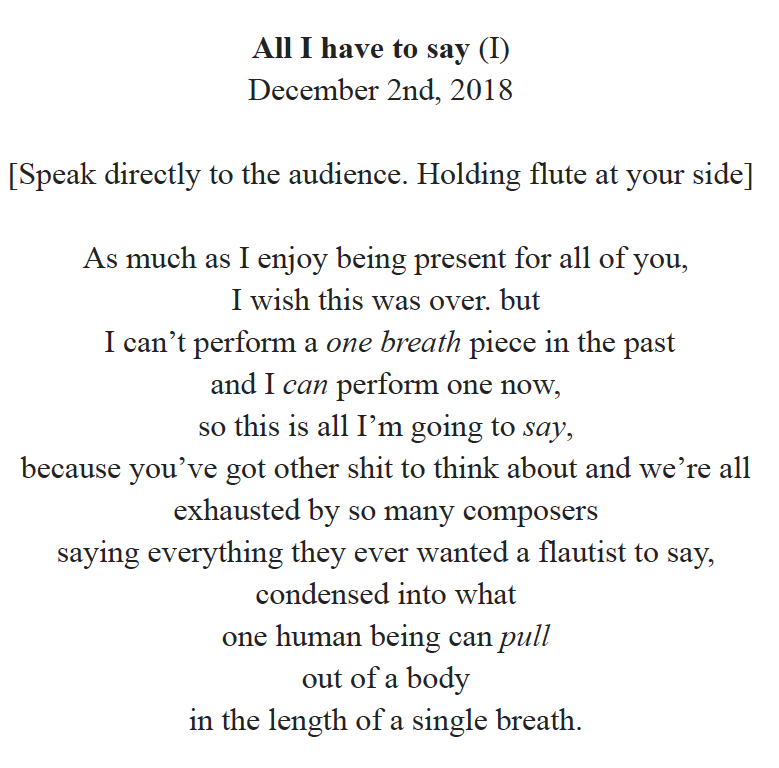
I began Coming Up for Air in 2017, after a period in which breathing had become extremely difficult and eventually required surgical intervention. As a flutist, I had become painfully aware of repertoire that often treats breath as an invisible resource: something the performer is simply expected to have enough of, control sufficiently, or disguise.
So I responded to physical restriction with another restriction. What could happen if composers were invited to write for flute using only one natural cycle of breath? Almost immediately, the apparently simple brief forced assumptions into the open.
Whose breath? Whose body? What had that body already endured? How long could it actually sustain sound? What could happen on the inhale as well as the exhale? Would the composer try to fill every available molecule, or leave me room to decide what happened inside it? What if the room I performed in triggered my allergies? Where did their idea end and my agency begin?
The restriction was tiny. The conceptual space inside was not.
More than 100 composers contributed to the project (and the call is still open). The pieces came from established composers, students, friends and strangers. Some arrived essentially complete. Others emerged through conversations, workshops and experimentation. In some I was recognisably a performer interpreting somebody else's work; in others my contribution became so entwined with the composition that those categories stopped making much sense.
My PhD thesis argued that the consistency and brevity of the one-breath constraint made Coming Up for Air an unusually rich way of looking at collaborative relationships: the musical objects were tiny enough that the processes around them could become especially visible.
Some of those breaths remained tiny. Some became gateways to enormous collaborations.
As Coming Up for Air approaches its tenth anniversary in 2027, I have started going back through the project and asking it different questions. I originally understood it primarily through breath, bodily limitation, performer agency, vulnerability, recovery and overcoming.
But there is another route through it now. This year I was diagnosed as autistic and ADHD (AuDHD).
AuDHD
AuDHD is not a separate diagnostic category, but a term increasingly used for the co-occurrence of autism and ADHD. Research into the lived experience of having both is still relatively young. Emma Craddock's study of women diagnosed with autism and ADHD in adulthood describes something I recognise strongly: the relationship between the two can be contradictory and complementary, with different traits conflicting, balancing one another or becoming more prominent in different contexts.
That feels very familiar to me. I can crave structure and novelty. Repetition and change. Completion and the irresistible possibility of opening another door. And Coming Up for Air seems accidentally to have found a sweet spot in that tension.
The rule never changes: one breath. There is repetition, structure and a satisfying little boundary around every piece. But inside that boundary almost anything can happen. Each work is small enough for me to hold in my attention and intense enough for me to disappear into. Then I can close that loop and immediately enter another completely different world.
Tiny but intense. Familiar but novel. The rule stays the same. The world inside it changes every time. Looking back, I can see that Coming Up for Air has been feeding my AuDHD brain for nearly ten years without me completely understanding why.
It feels like an advent calendar that offers shockingly good value. Behind every tiny door is a completely different world that might make you laugh, cry, get splashed, or think, WTF just happened?
The problem is that my brain now wants to open all the doors at once. That makes writing about the project almost comically difficult. I want to close loops and open them at the same time. Every example seems to lead to dozens more; every collaboration contains another story I want to tell.
So this essay follows only a handful of them: pieces that taught me something about agency, safety, access, authorship, empathy, friendship, transformation and the strange conditions that allow people to make things together.
There are more than a hundred other stories behind the remaining doors. I’d love to tell them all.
Sometimes the score is only part of the invitation
Some Coming Up for Air pieces also taught me that notation can create very different kinds of relationships between composer and performer.
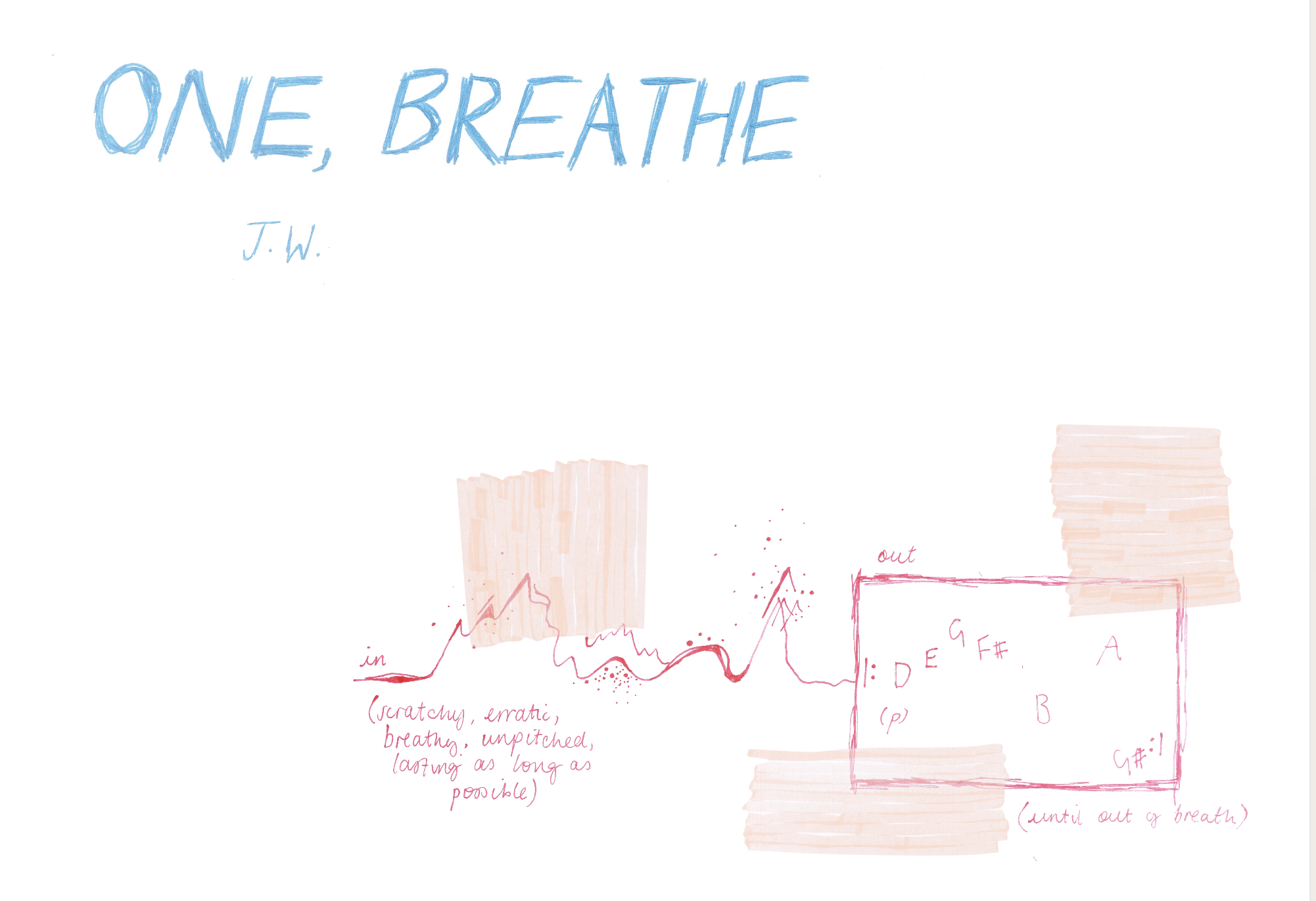
Joanna Ward’s One, Breathe is genuinely open in the way its graphic score functions. The notation gives me material and direction, but its realisation depends substantially on choices I make in performance: how I navigate it, how I shape the sounds, how I manage my breath and body.
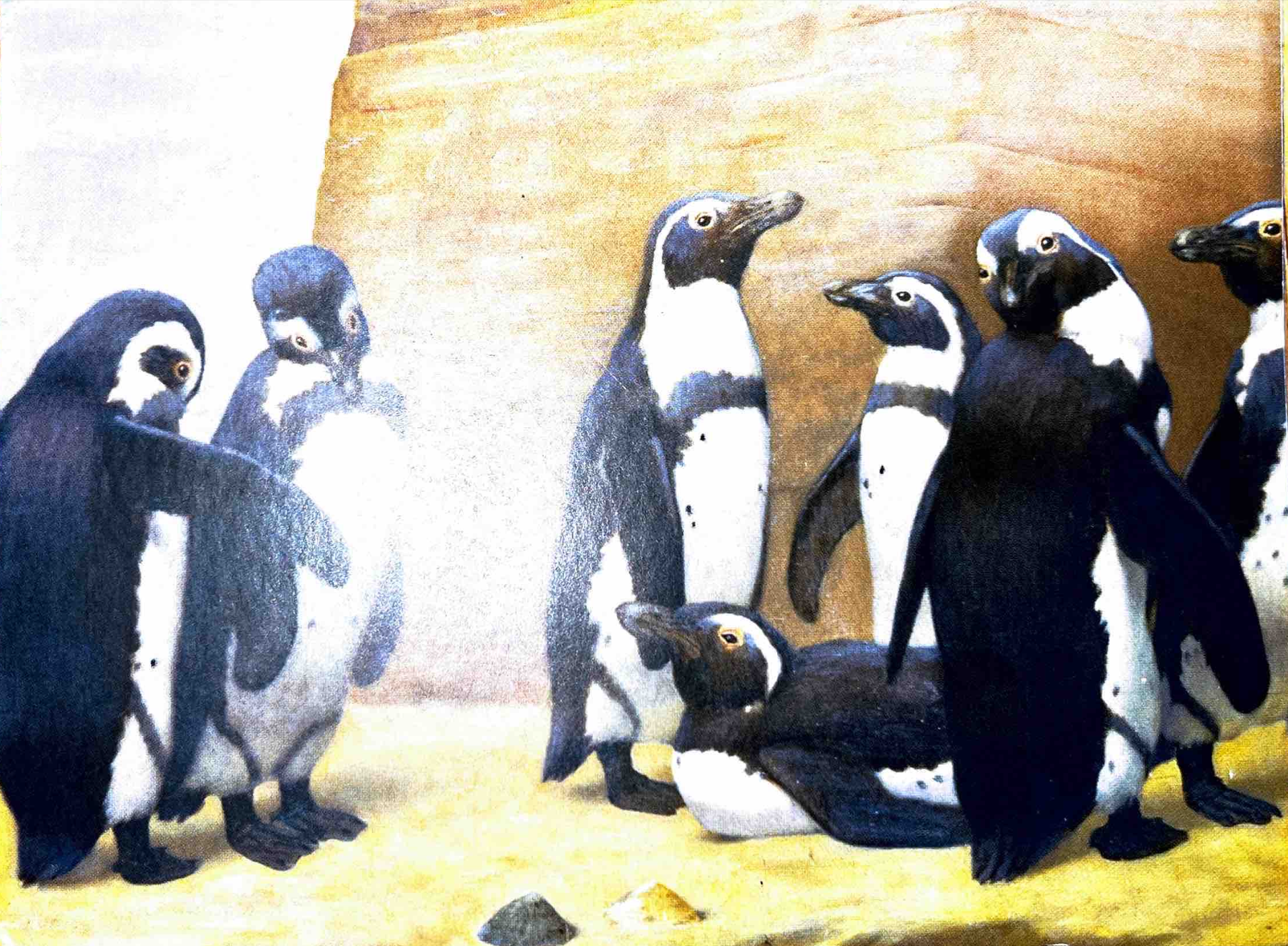
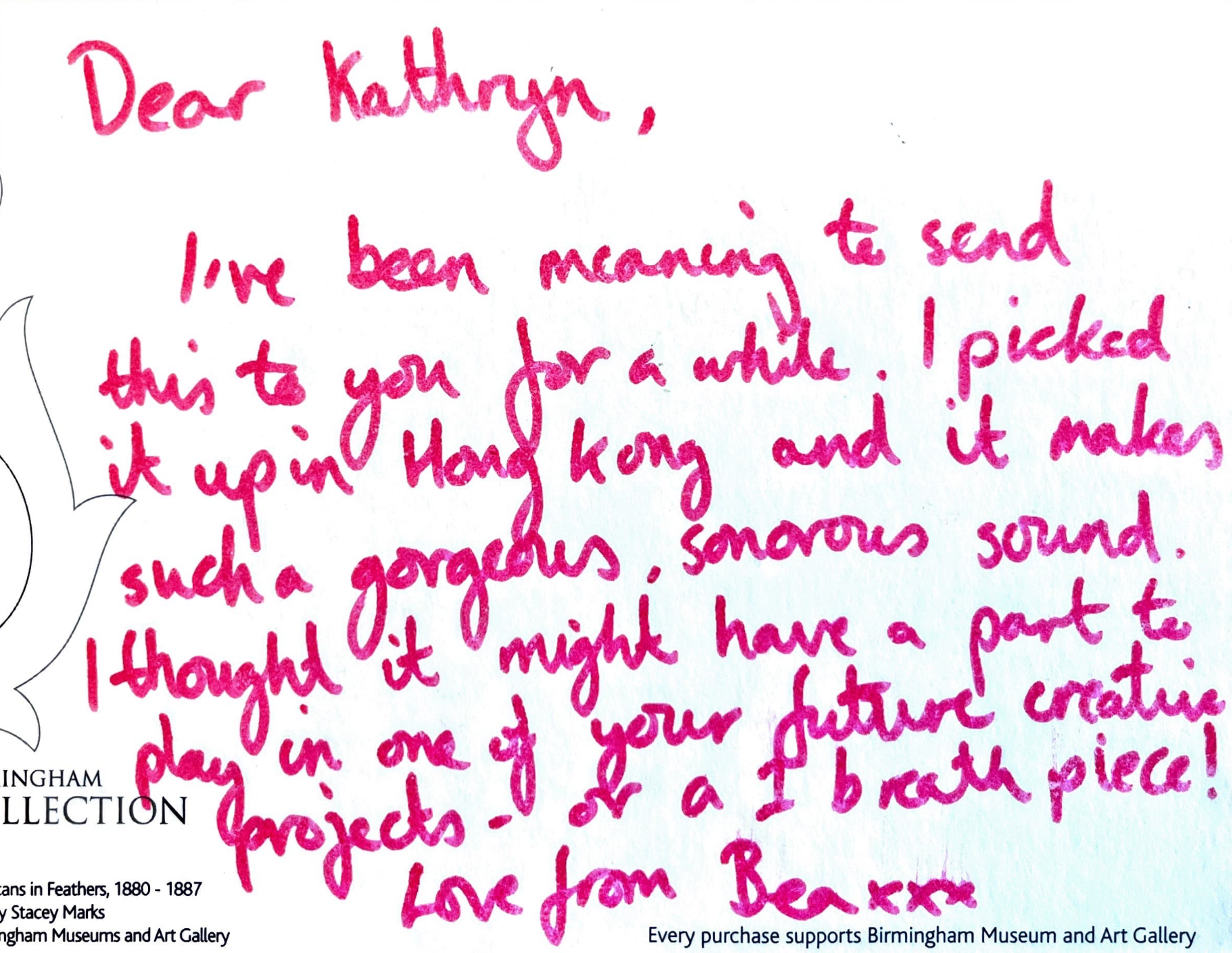
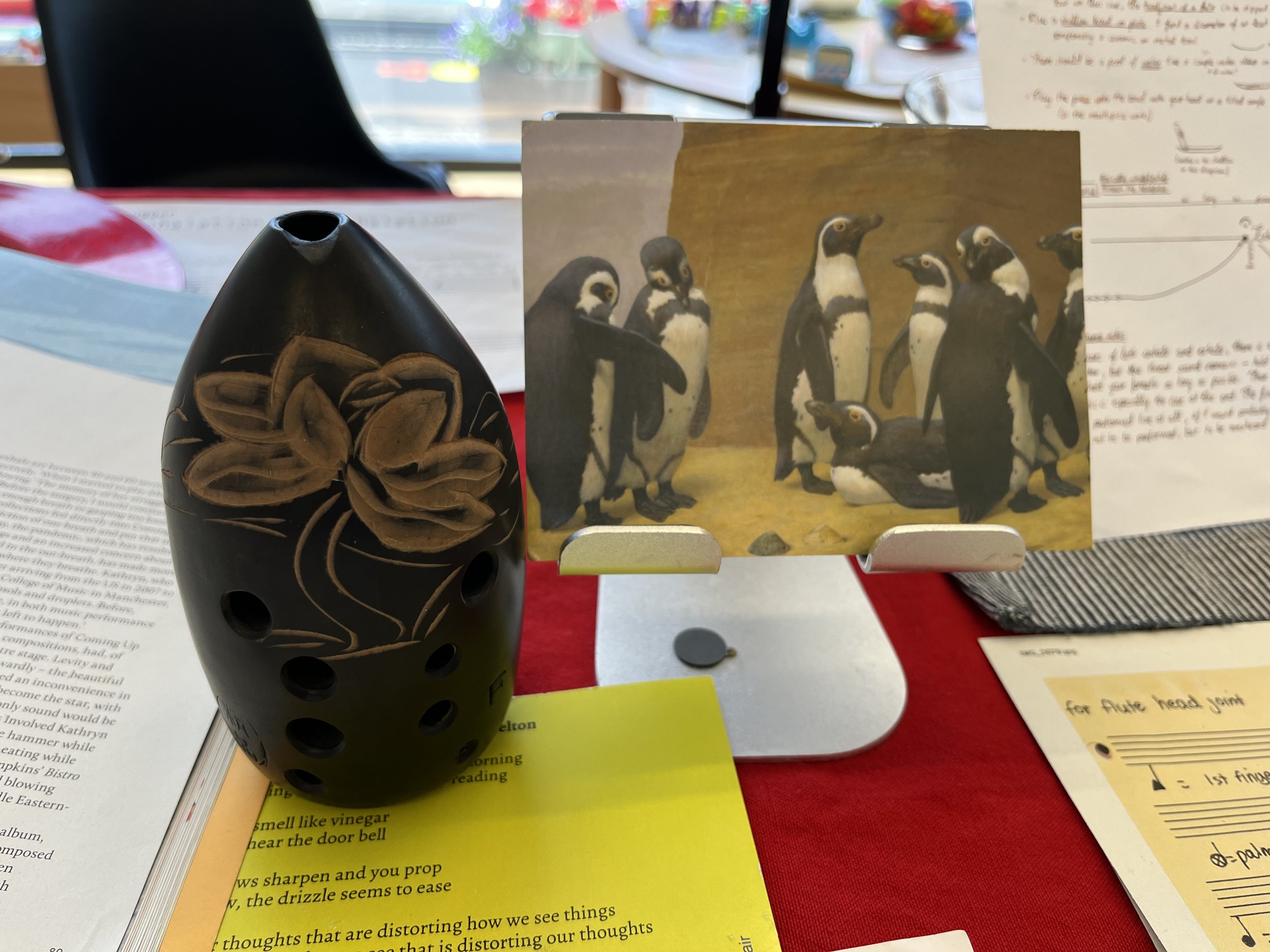
Bea Hubble’s Penguin Postcard sits somewhere stranger and more playful. Bea sent me an actual postcard with adorable penguins on it, together with a small ocarina. On the back she wrote that she had picked it up in Hong Kong because it made “such a gorgeous, sonorous sound” and wondered whether it might become part of one of my future projects “or a one breath piece!”
It is a graphic score of sorts, but perhaps more importantly it is a gesture between friends: an image, an object, a sound, and an invitation. There is very little prescription. Instead, she gave me materials and trusted me to find out what they might do.
I love that as a model of collaboration. Sometimes somebody does not hand you a finished idea. They hand you a possibility. I saw this. I heard this. It made me think of you. What might happen if I gave it to you?
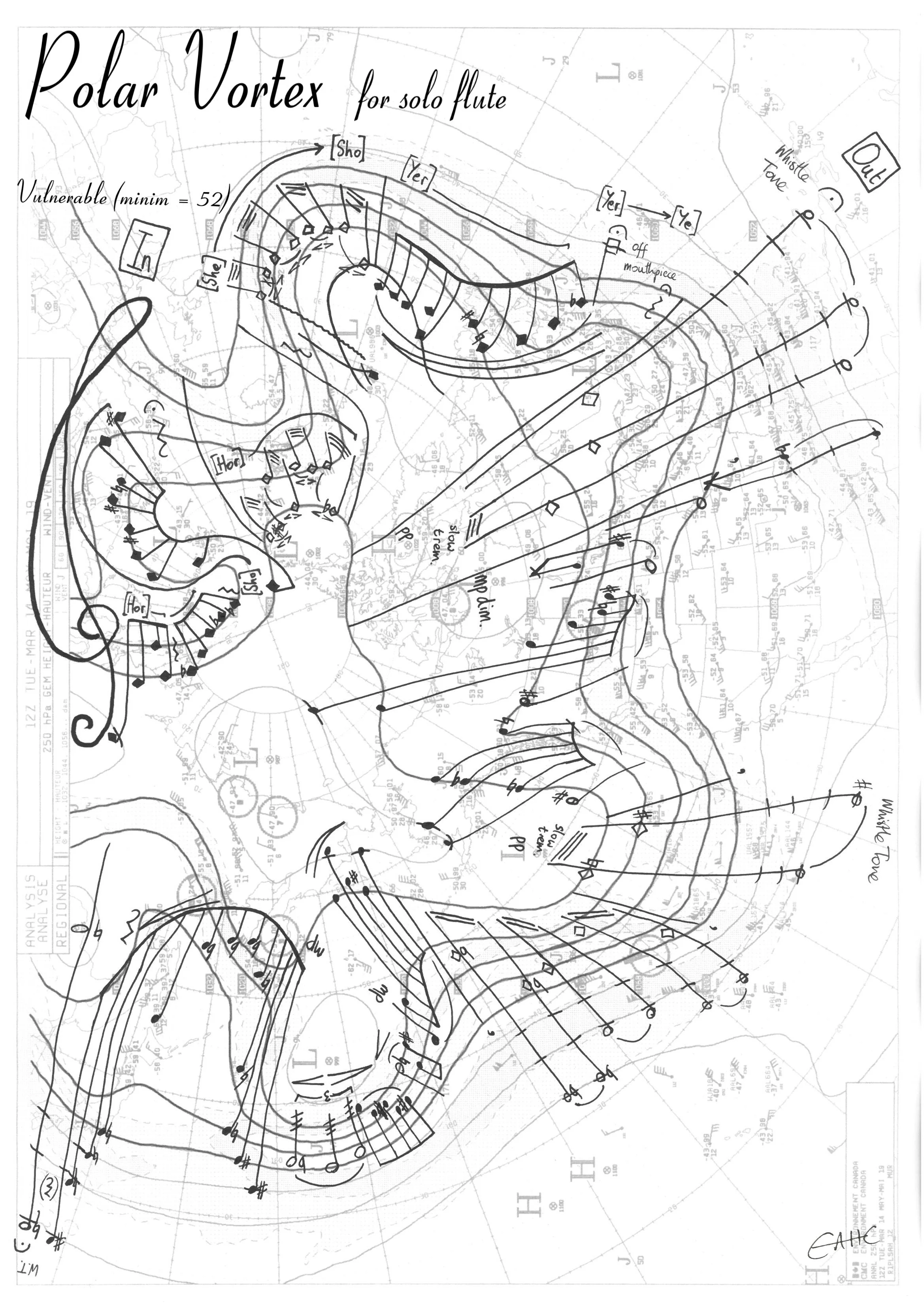
Ewan Campbell’s Polar Vortex complicates things again. Its projected score looks extraordinarily graphic: notation curls and sweeps across a meteorological chart, inviting the eye to wander through it. But the performance copy is actually closely specified in standard notation.
So visual freedom and performative freedom are not the same thing.
A score can look open while prescribing a great deal. Another can look simple while requiring enormous interpretative agency. And something that barely looks like a score at all. A postcard from a friend can become a musical invitation.
What matters to me increasingly is not whether something can be categorised as a graphic score, but what kind of relationship the notation establishes.
Does it prescribe? Suggest? Invite? Provoke? Leave room to answer back? And how much of myself am I allowed to bring to it?
I thought I was looking for artistic chemistry
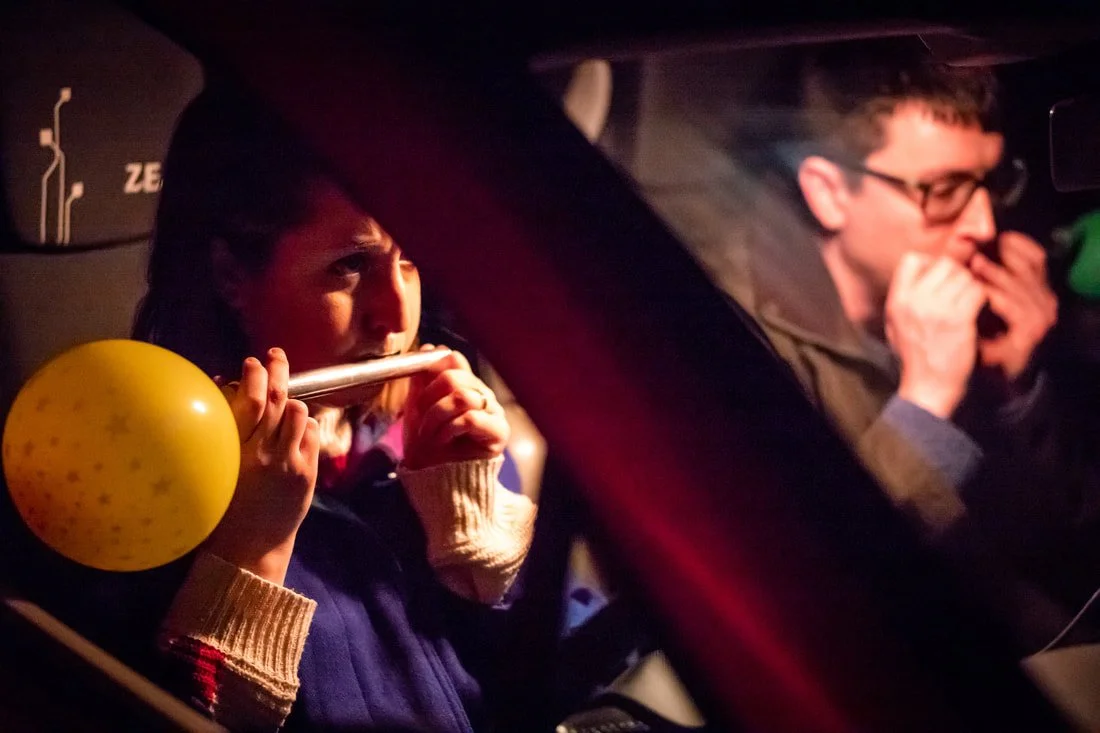
Andy Ingamells and Kathryn perform in an electric car.
Looking back, I can see that I repeatedly gravitated towards particular kinds of collaborators. People who could become intensely absorbed in an idea with me. People who were sensory-seeking, curious, playful. People who could sit comfortably in silence and then talk almost without stopping for hours. People who would follow a conversational tangent somewhere apparently irrelevant and trust that eventually we might discover why we had gone there. People who weren't frightened by enthusiasm, repetition, strange ideas or suddenly becoming extremely interested in one tiny thing.
The collaborations in which I felt safest usually had a particular kind of give-and-take. There was room to become intensely focused and room to drift. Nobody seemed especially alarmed if we arrived with far too many thoughts, or none. Silence did not automatically mean rejection. Excitement was not embarrassing. We could follow one another into strange places.
At the time I would probably have called that artistic chemistry, but now I wonder whether some of it was compatibility between nervous systems.
My diagnostic assessment gave me language for another part of this. Social interaction can require substantial conscious processing for me. While somebody is speaking I may also be monitoring their facial expression, eye contact, tone, body language and conversational timing; wondering whether I am talking too much or too little; trying to establish what they expect from me and whether I am performing the interaction correctly. Sometimes there isn't enough processing capacity left for the actual words.
My assessment describes delayed processing during interactions. I may appear engaged and verbally fluent but leave a conversation only later realising that I misunderstood information or failed to recognise an underlying meaning. The assessment itself demonstrated the same discrepancy: an articulate and socially engaged outward presentation alongside considerable conscious effort devoted to processing and self-monitoring.
That matters in collaboration.
I can realise several hours after a rehearsal what somebody meant. I can discover afterwards that what I heard as an instruction was actually an invitation to disagree. I can agree to something before I have worked out what I think. I can miss an implication or somebody else's discomfort in the room and suddenly understand it later.
Sometimes the really useful artistic thought arrives after everybody has gone home.
That can have an artistic cost. In freelance music it can have an economic cost too.
So much work depends on informal relationships, recommendations and repeat bookings. Nobody says, that interaction didn't work for me. You simply don't get asked back.
That is a fairly brutal feedback mechanism for somebody who struggles to infer intentions and unspoken expectations in real time.
Going forward, I want to be much more explicit about that.
Sometimes I don't know yet is my most accurate answer. Sometimes I need to come back to you tomorrow. Sometimes I need that in writing. Sometimes I need to ask what did you mean by that? And shed the embarrassment about it.
Those things aren't disengagement from a creative process. They are how I can participate in it properly.
Sometimes tiny ideas need room to get enormous
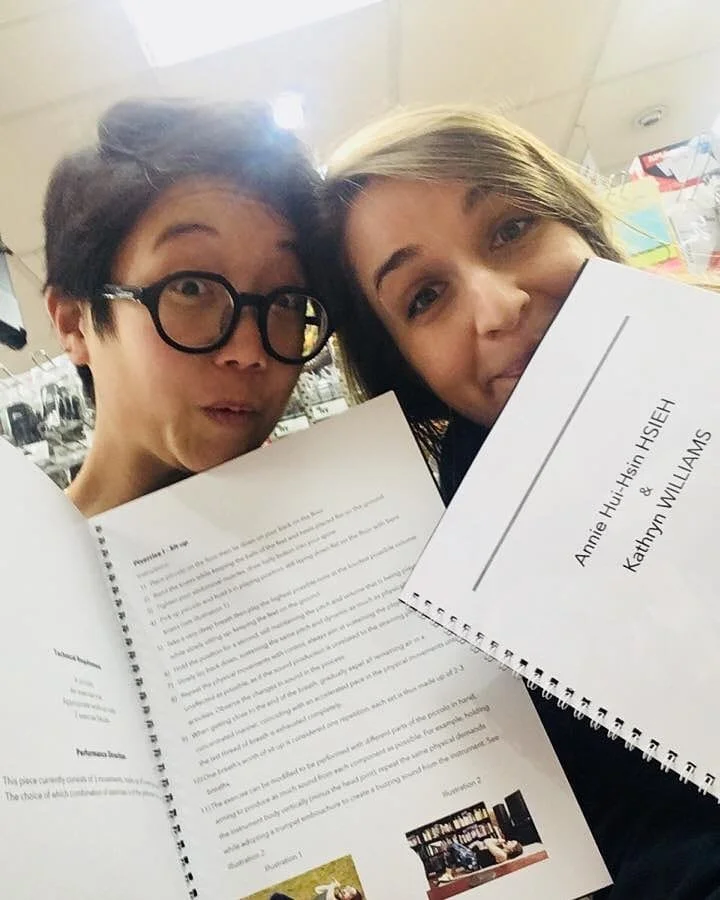
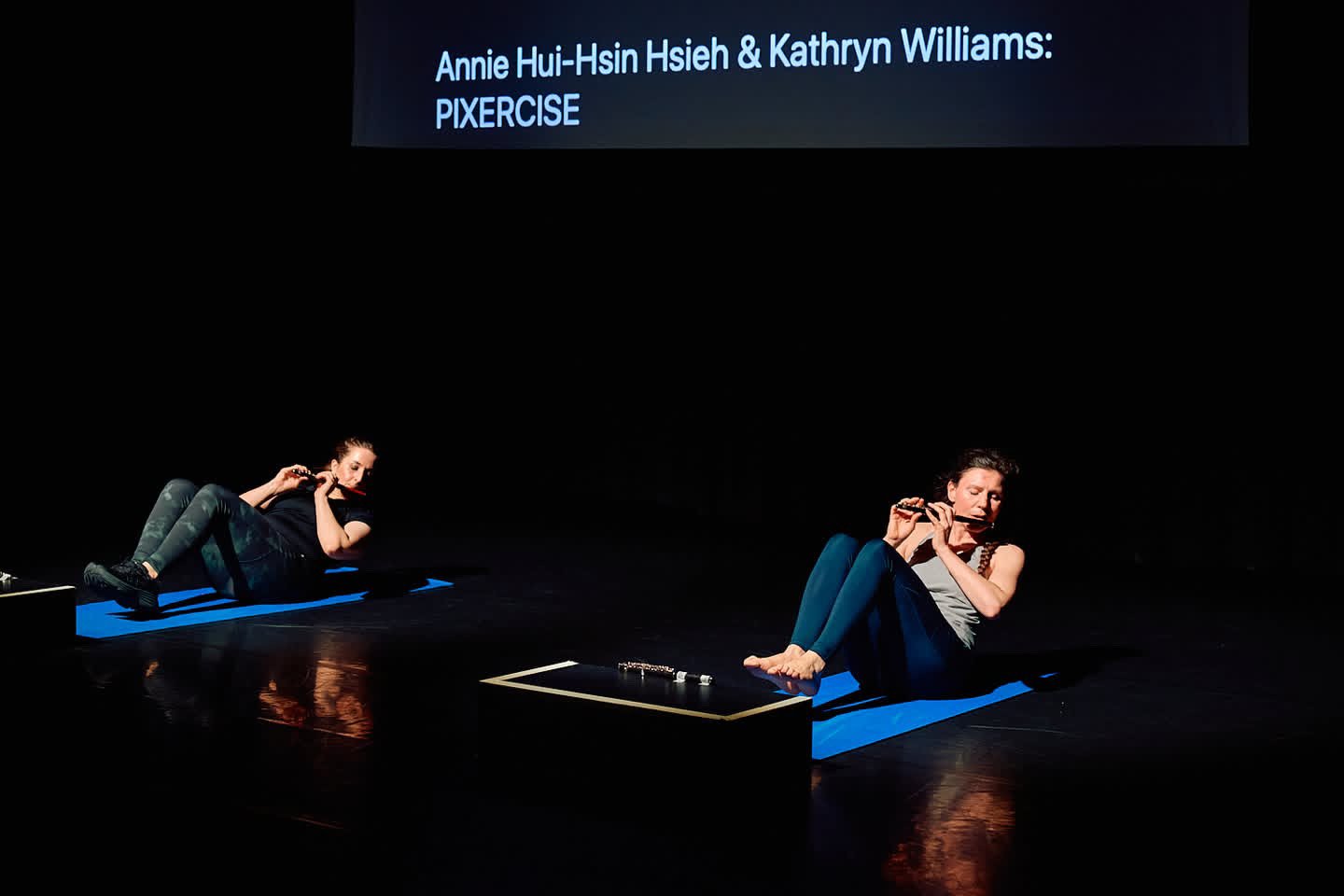
Annie Hui-Hsin Hsieh's original contribution to Coming Up for Air was wonderfully ridiculous. Sitting together on the grass on a break from an intense day working at Royaumont Abbey, Annie asked me to sustain a high note on the piccolo while doing as many sit-ups as I could manage in a single breath. Onlookers laughed. Then we kept looking at it.
The joke contained something more complicated: physical strain, virtuosity, female body image, expectations of perfection, and the peculiar demands we place on performing bodies. It also connected with something much more personal.
Coming Up for Air had always been bound up with ideas of overcoming and transformation. It began as part of my recovery from illness and surgery, and as an attempt to regain some agency over a body that had repeatedly felt beyond my control. With PIXERCISE, that idea moved somewhere I hadn't anticipated. For years I had avoided gyms because I associated them with fear and flashbacks following experiences of violence. Developing the piece gave me a reason - and, importantly, a framework - to return.
I invested my own time and money in working with a personal trainer over many months. Training became part of the artwork, but it was also real life. I became stronger. I learned what my body could do. I returned repeatedly to a space I had previously found frightening and gradually built a different relationship with it.
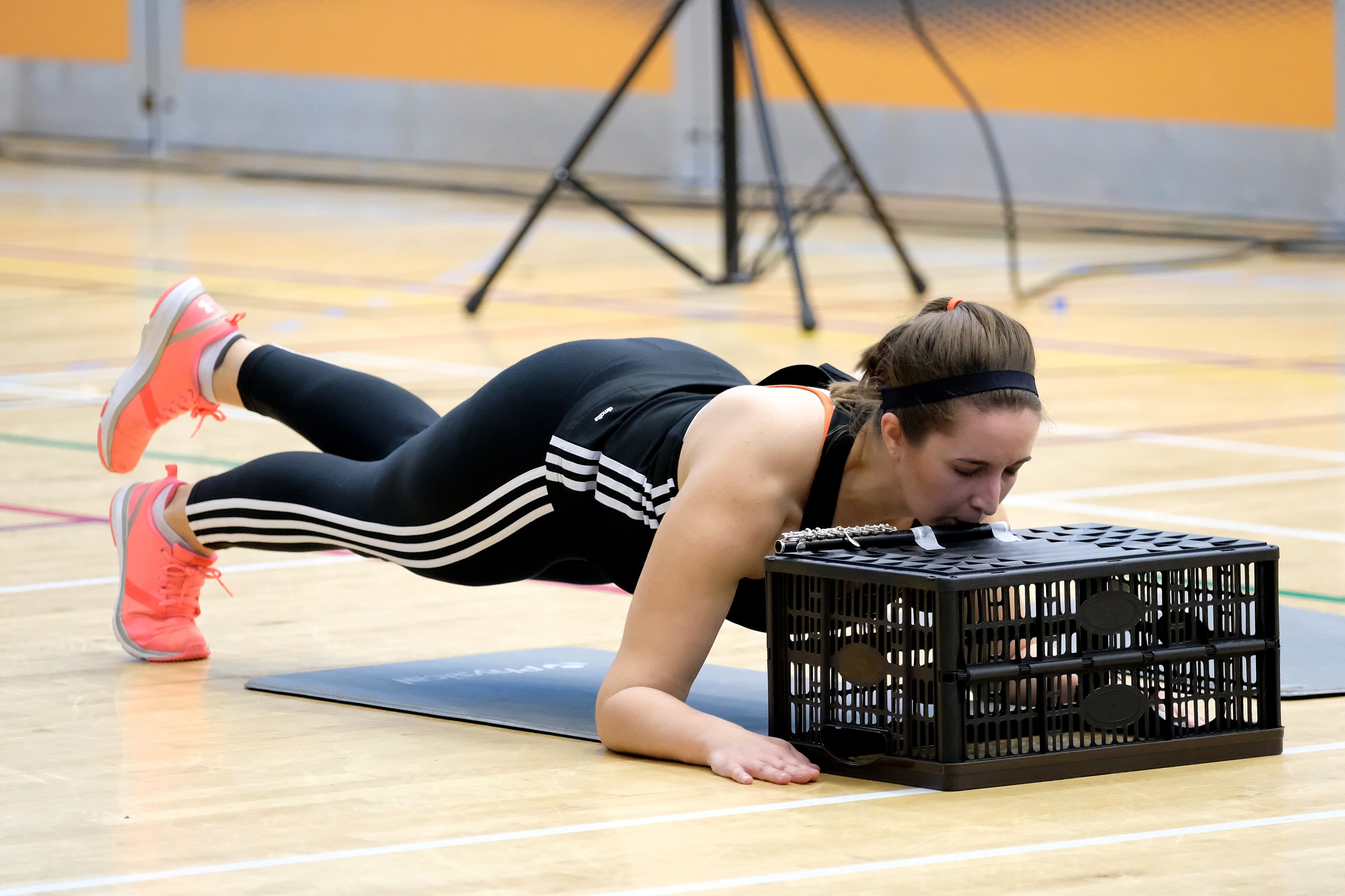
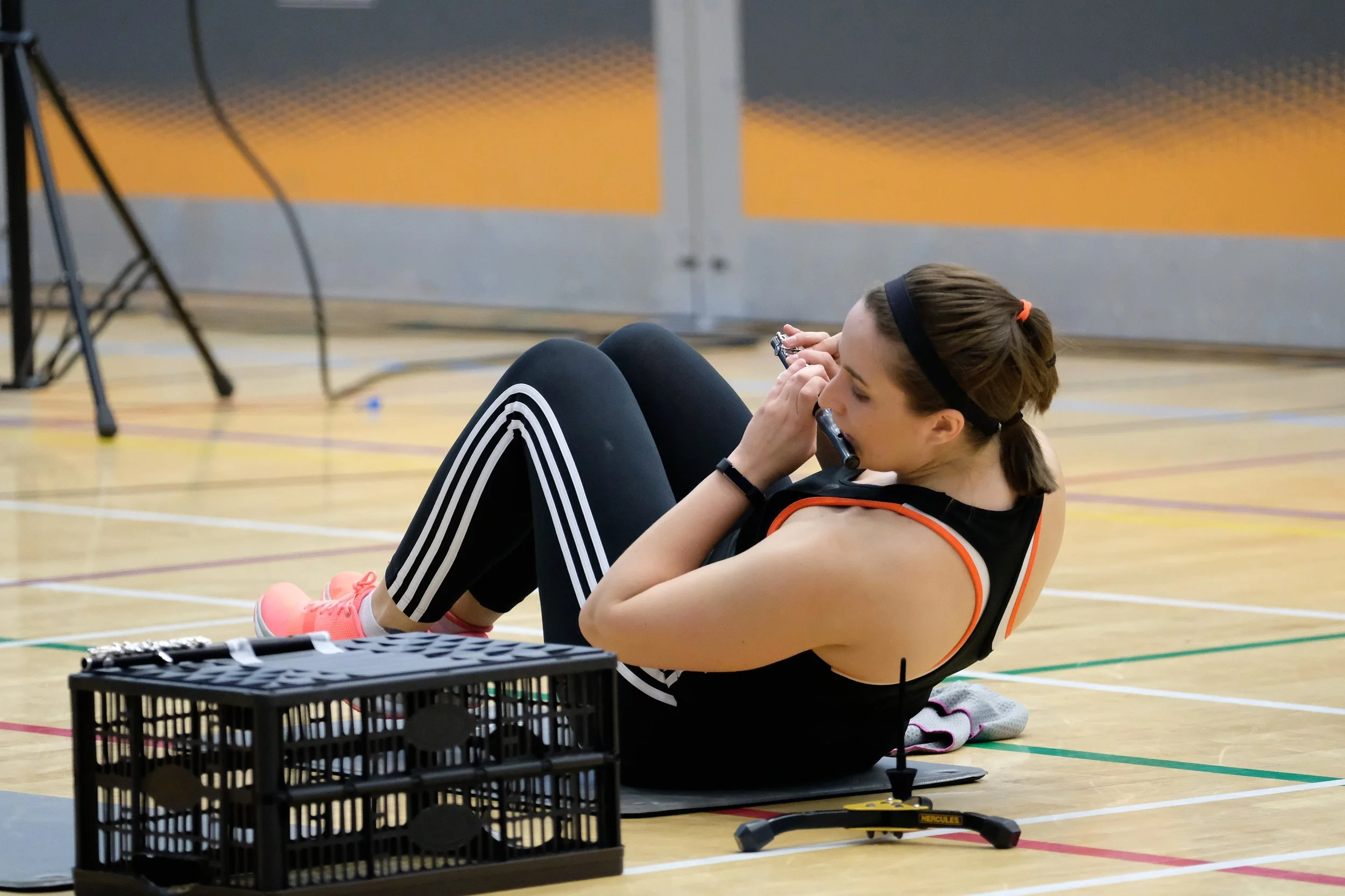
Kathryn performs a one-legged plank while blowing into a piccolo head joint which taped onto a crate. 2018, HCMF. Photo by Brian Slater.
That single-breath piece eventually became PIXERCISE, a twenty-minute co-composed work combining high-intensity interval training and piccolo playing. The process incorporated the intimate sounds of breathing, saliva, effort and exhaustion, captured through a microphone worn around my throat.
The work gave me a structure in which I could approach something difficult while retaining control over the terms of that approach.
Artistically, I wasn't simply being given increasingly extreme instructions to execute. Annie provided ideas, support and stimulus, but I retained autonomy over what was happening to my body. We experimented together. The work became jointly authored. That distinction matters enormously. There is a difference between:
I have invented an extreme thing. Please execute it.
and:
Here is an idea. What happens if we explore it together?
Both might eventually produce something physically spectacular. But if the composer had instructed me to pay for a trainer, return to a gym I had avoided through fear, and reshape my body in order to realise their artistic idea, that could have been an act of aggression. The crucial difference was that I chose it. I had support, but I retained agency.
In retrospect, I think that agency was part of what made transformation possible. I could push myself because I wasn't surrendering control. The collaboration gave me something to push against without taking away my ability to decide how far, how fast, or in what direction I went.
That complicates the idea of artistic safety in a way I now find fascinating. PIXERCISE was not safe in the sense of being gentle. It was exhausting, exposing and physically demanding. But the conditions around the risk were sufficiently safe for me to choose it. And that choice changed things beyond the artwork.
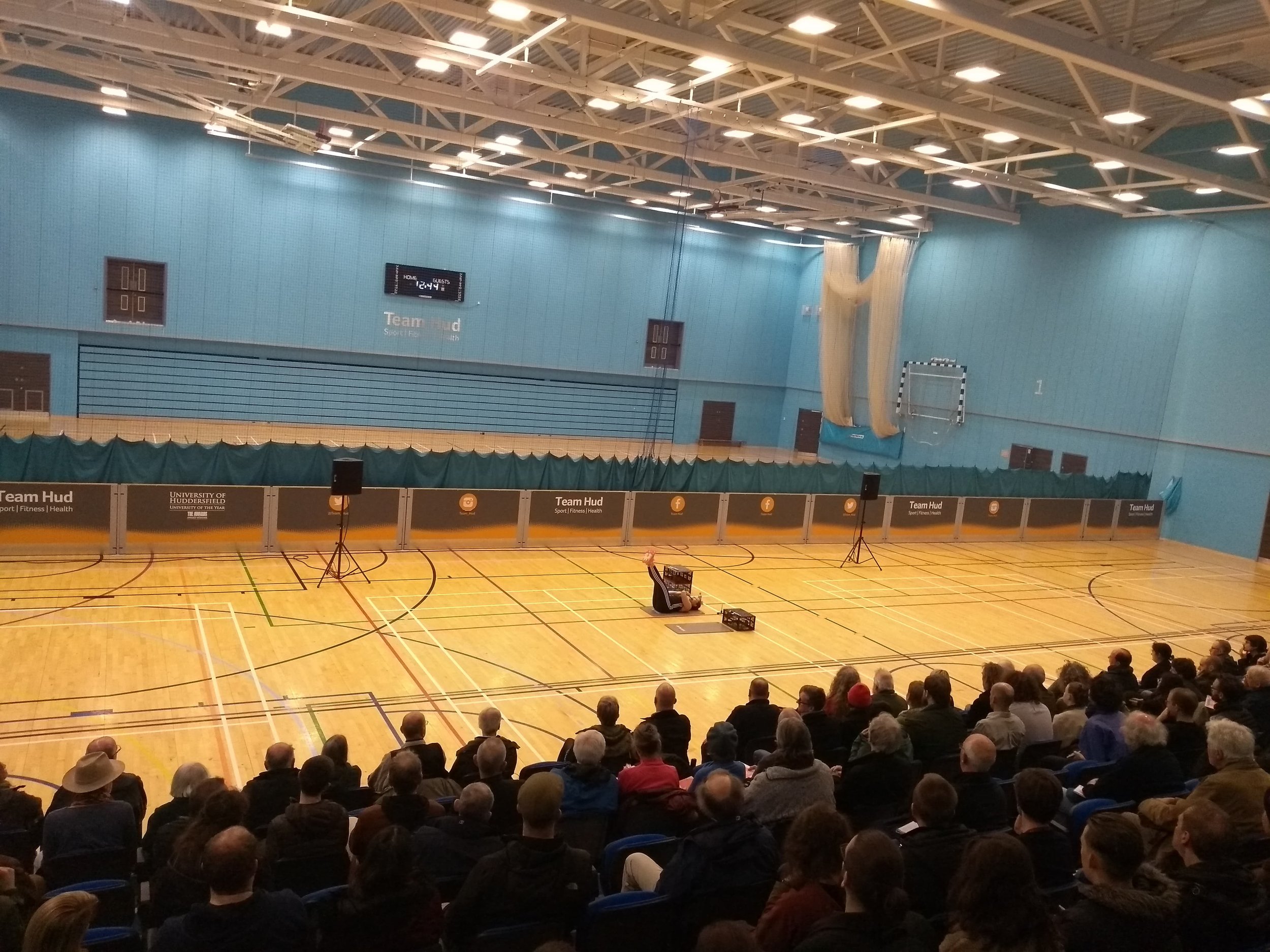
Looking at PIXERCISE now, as I approach the tenth anniversary of Coming Up for Air, I recognise one of the patterns I am becoming increasingly interested in. A “silly” one-breath piece became a twenty-minute work, premiered at Huddersfield Contemporary Music Festival in the University of Huddersfield Sports Hall. It became a long-term collaboration and friendship. And a framework for personal transformation.
Sometimes the collaboration keeps changing shape
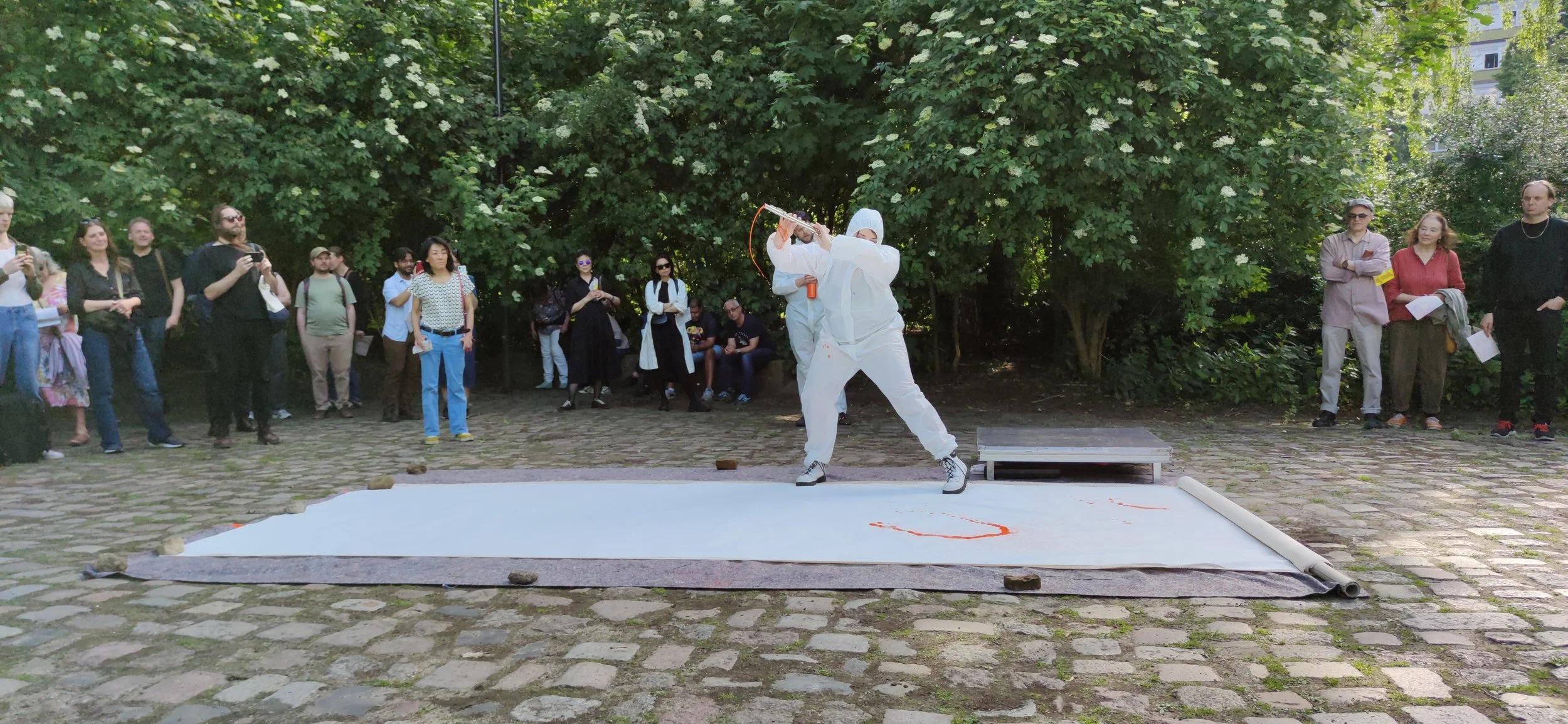
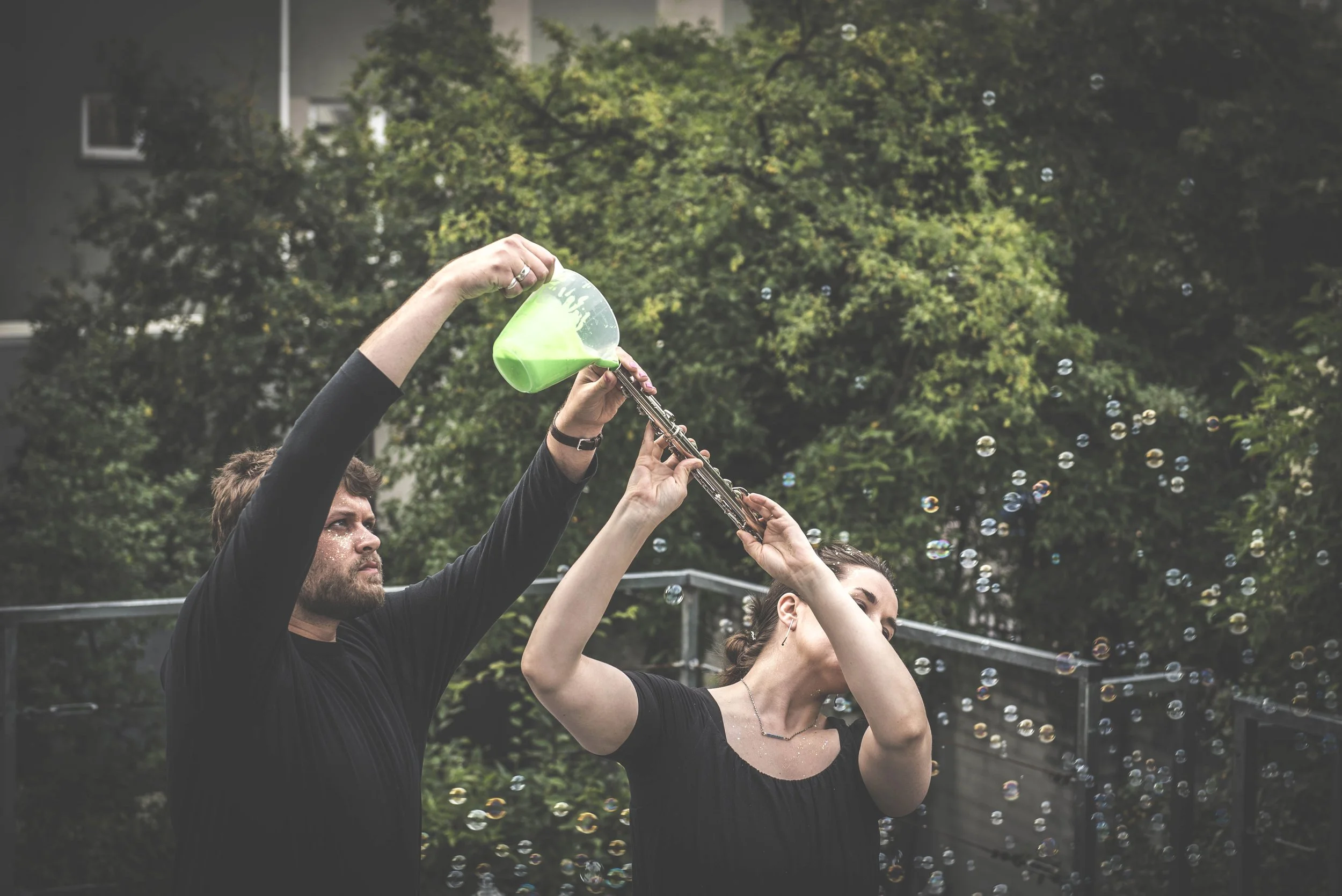
Ed Cooper's For Kathryn Williams began with a wonderfully literal way of making breath visible. A (spare) flute is filled with dyed water by an assistant (Ed); when I blow through it, the water sprays and dribbles onto a canvas. My breath doesn't simply realise the score - it helps make one, producing a visual artefact in real time. In my PhD I described it as perhaps the most direct example in Coming Up for Air of visible breath becoming a graphic score. But the piece didn't end there.
Ed and I have gone on to perform it together in many different places, from a rooftop in Warsaw to a giant canvas in Berlin. What began as one contribution to Coming Up for Air became an ongoing artistic relationship, and over time that relationship has taken other forms too. Ed has also travelled with me as an Access to Work support worker, helping with some of the practical and logistical conditions that allow me to perform and work. I find that especially interesting now.
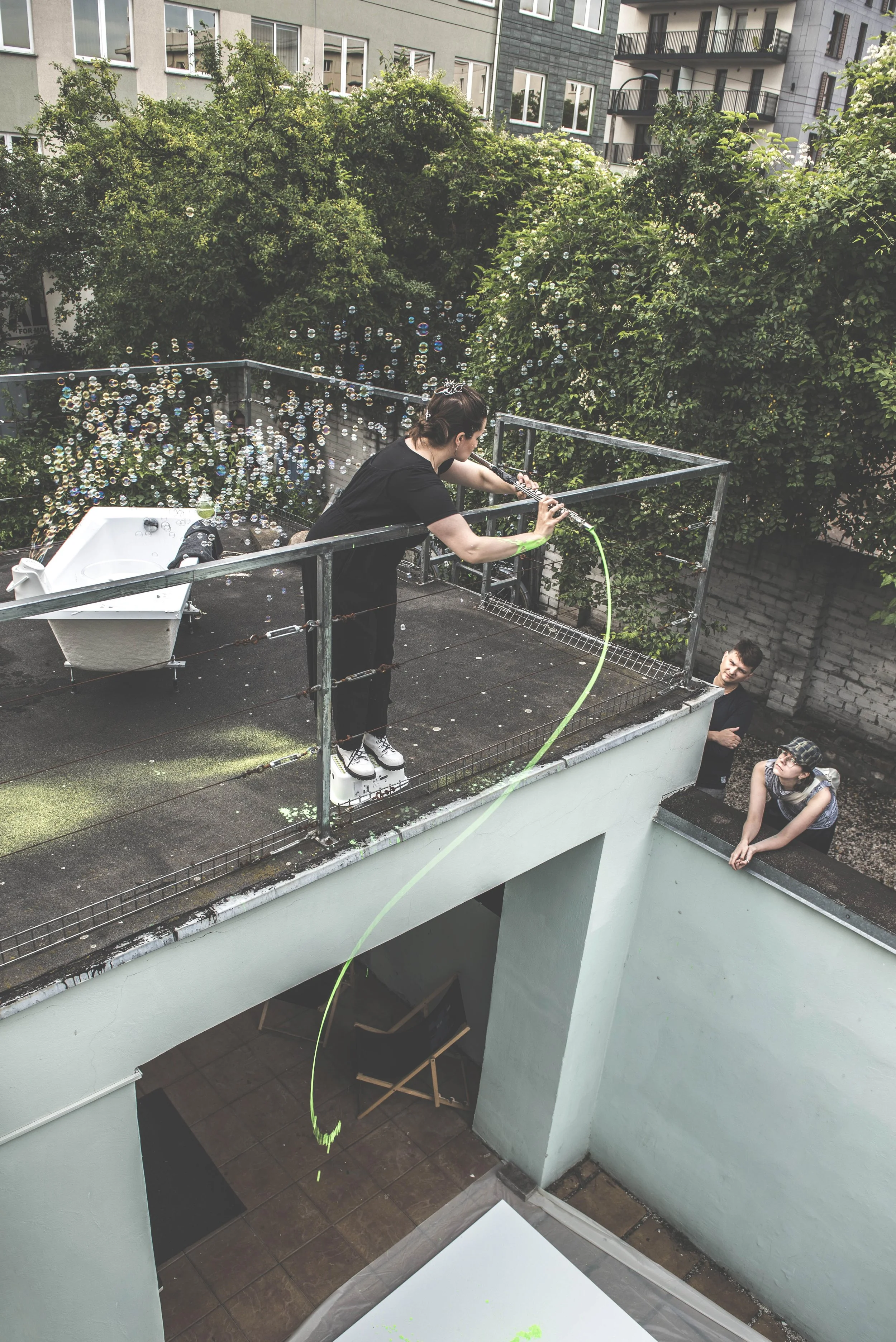
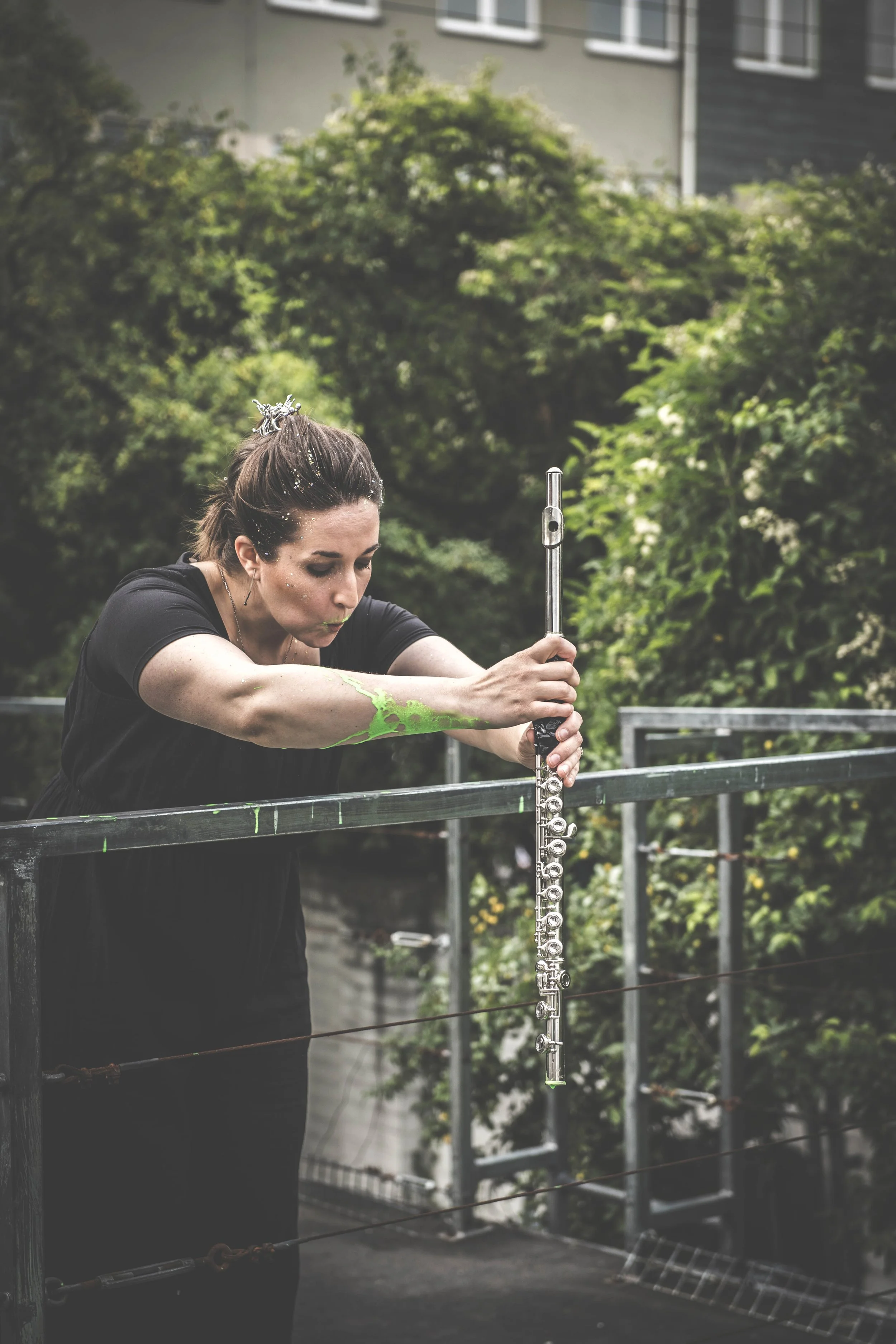
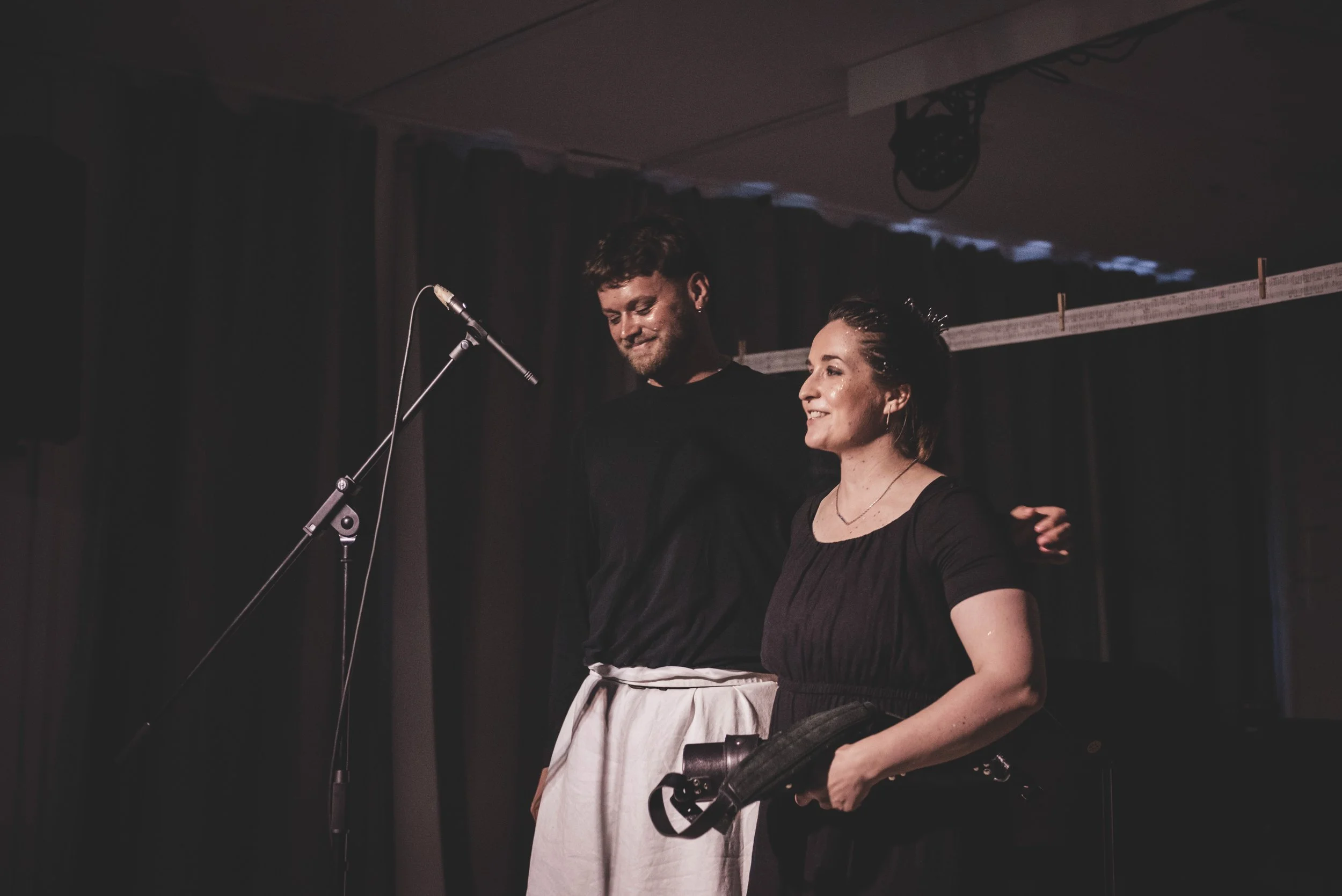
We often talk about professional relationships as though everybody occupies a stable role: composer, performer, producer, assistant, support worker. But real creative lives are much less tidy. Trust accumulates. Somebody who began by making a piece with you may later become part of the infrastructure that allows you to make other pieces at all.
That doesn't make every role interchangeable, and it doesn't remove the need for clear boundaries or proper payment. But it does remind me that collaboration can have a life beyond the artwork itself.
Sometimes what grows from one breath is another piece. Sometimes it is a friendship or a working relationship. Sometimes it is simply somebody who knows enough about how you work that you don't have to explain yourself from the beginning every time. And that, too, can make ambitious work possible.
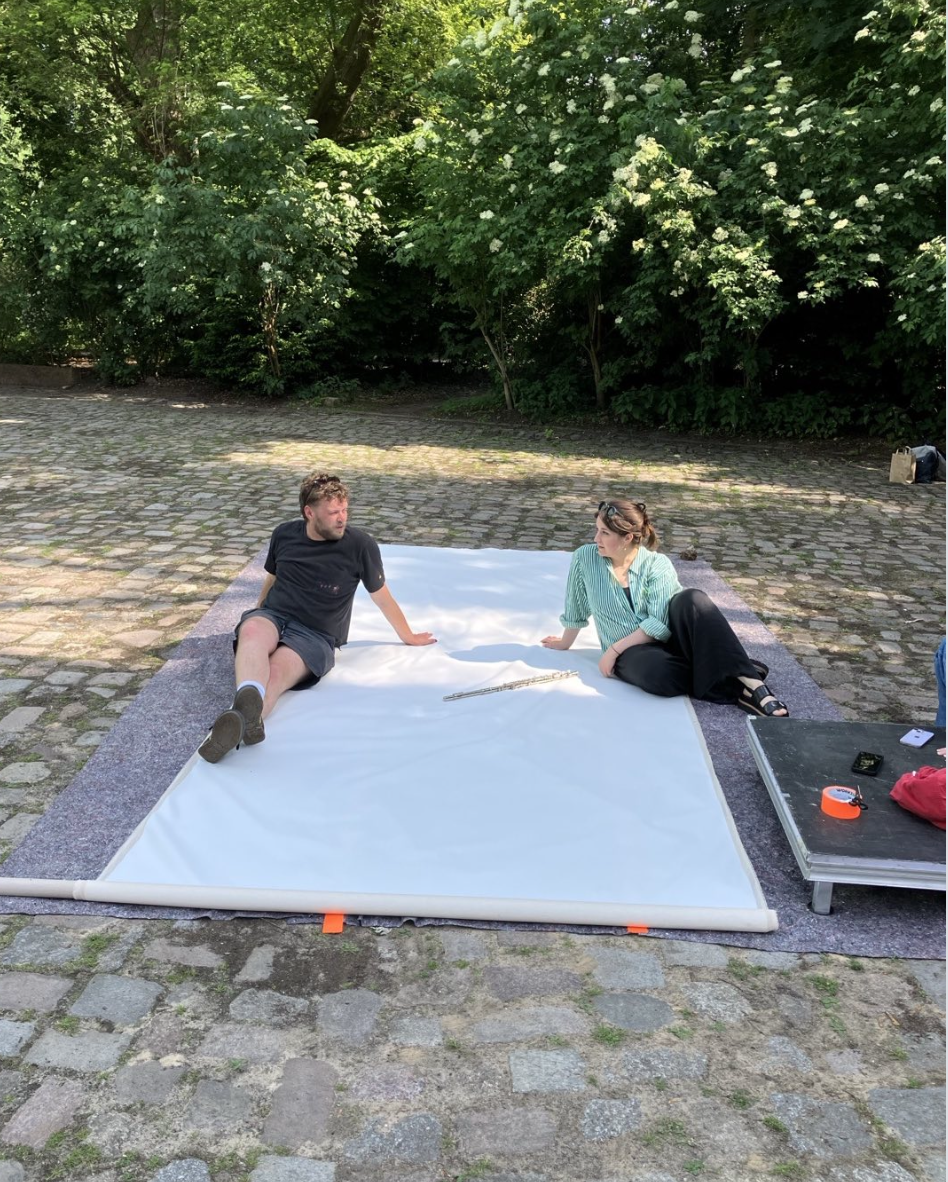
Ed and Kathryn rehearsing at Akademie dur Künste 2025.
Sometimes safety means somebody stepping back
Mark Dyer's Memento for Kathryn (and being able to hold that forever) grew in a different direction.
Our starting point became my own experience: respiratory illness, sinus surgery, recovery, and my complicated history with the opening flute solo from Debussy's Prélude à l'après-midi d'un faune - a passage which, in orchestral auditions, is often expected to be performed in a single breath.
The resulting piece contains fragments of me talking about surgery, recovery and Debussy, alongside my giggling - as I often do when I'm excited - and brief swirls of distorted orchestral sound.
I sit on a chair, poised like a principal flautist waiting for her moment of crowning glory.
For around a minute and twenty-four seconds, I gradually build a single inhalation. I am only allowed to breathe in during the brief orchestral swirls. Eventually I am completely full of air.
Then I extend the flute out at arm's length and try to direct my airstream towards a lip plate that is far away from my face. At first, the connection is almost impossibly fragile: the faintest trace of the familiar C-sharp–B–A-sharp–A–G-sharp–G pattern emerges. Slowly I bring the flute back towards my mouth, allowing my airstream to connect more securely with the instrument.
The sound never develops into anything approaching orchestral splendour. It barely gets beyond a whistle tone. But I am still trying to play the opening of Debussy in one breath.
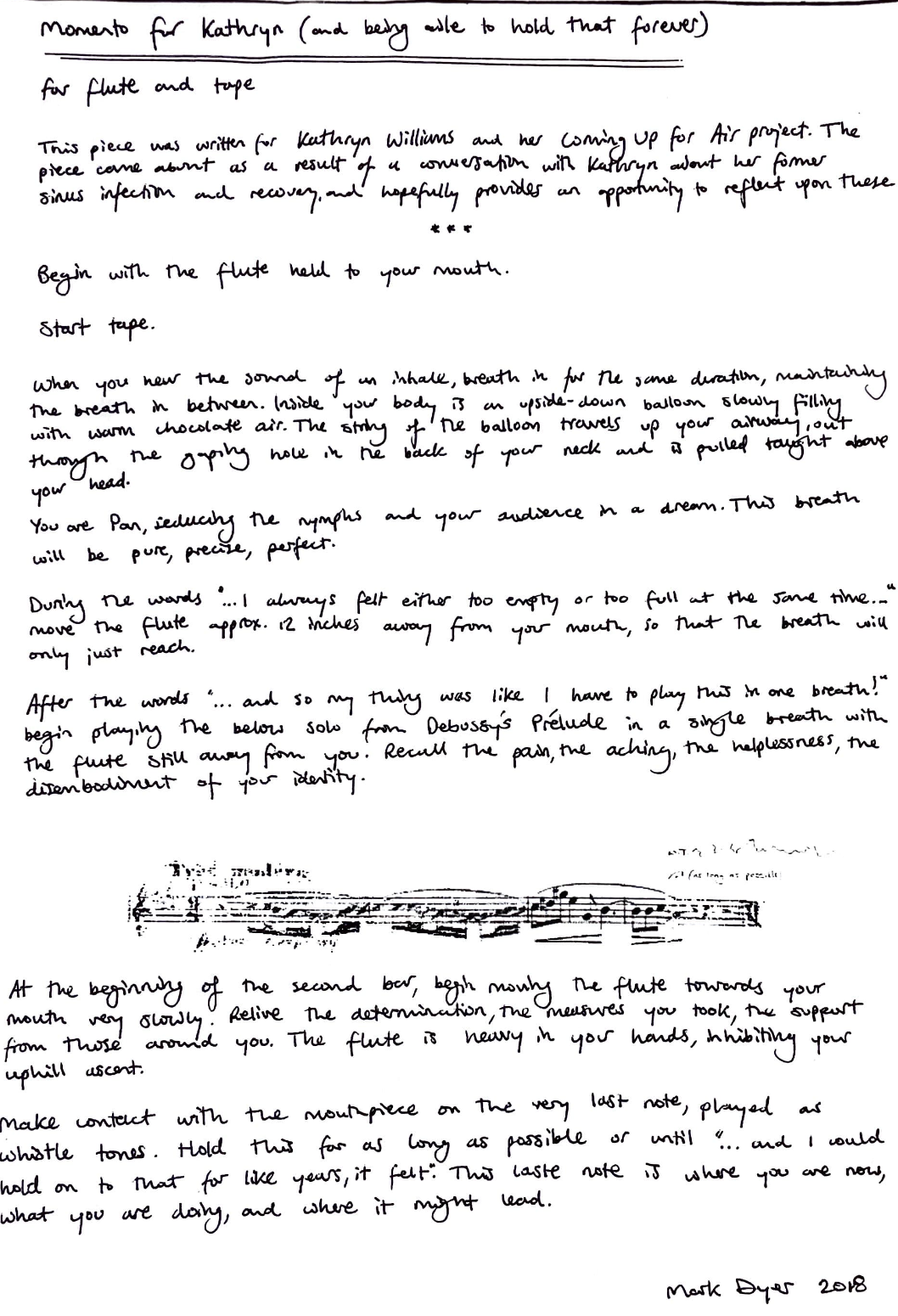
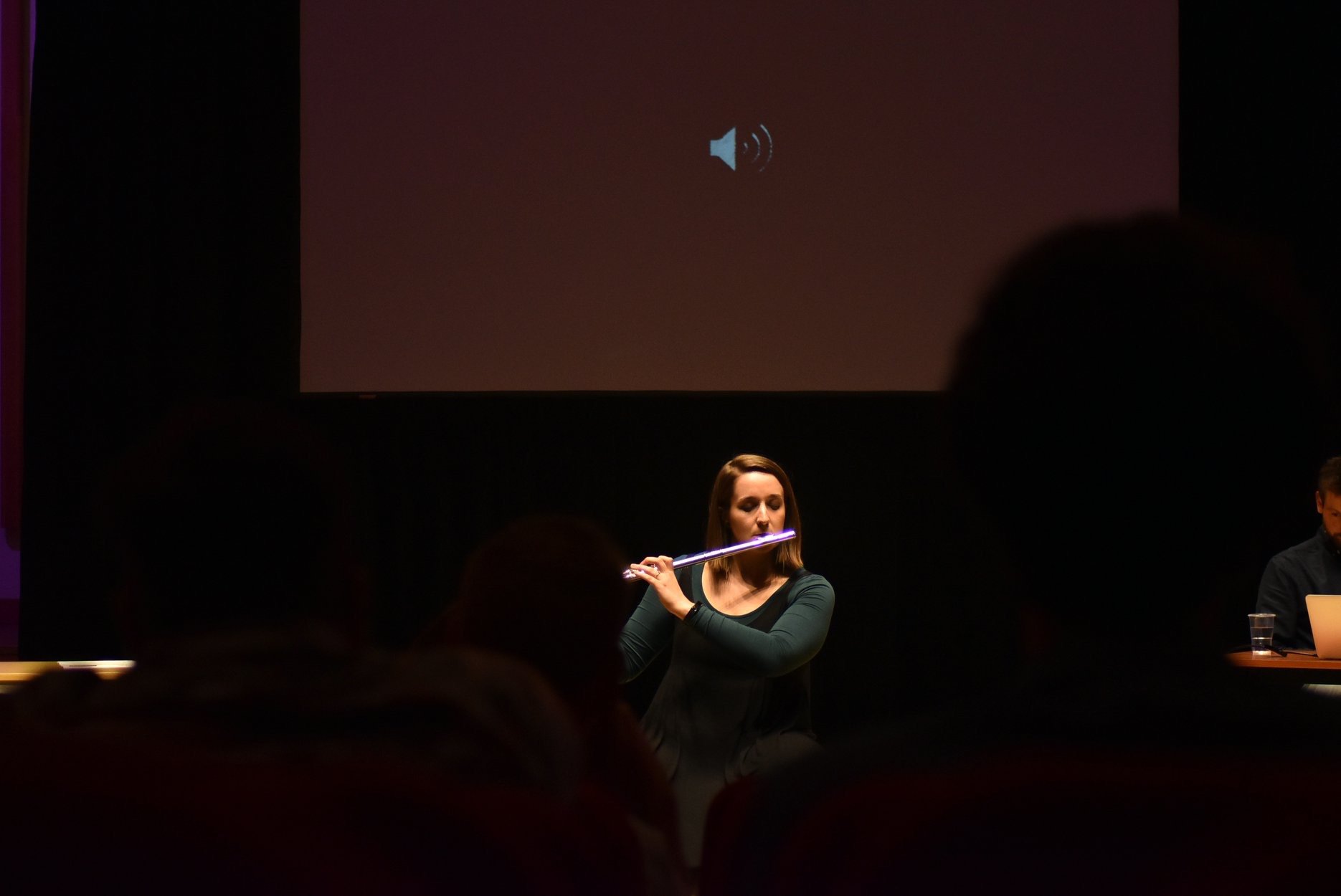
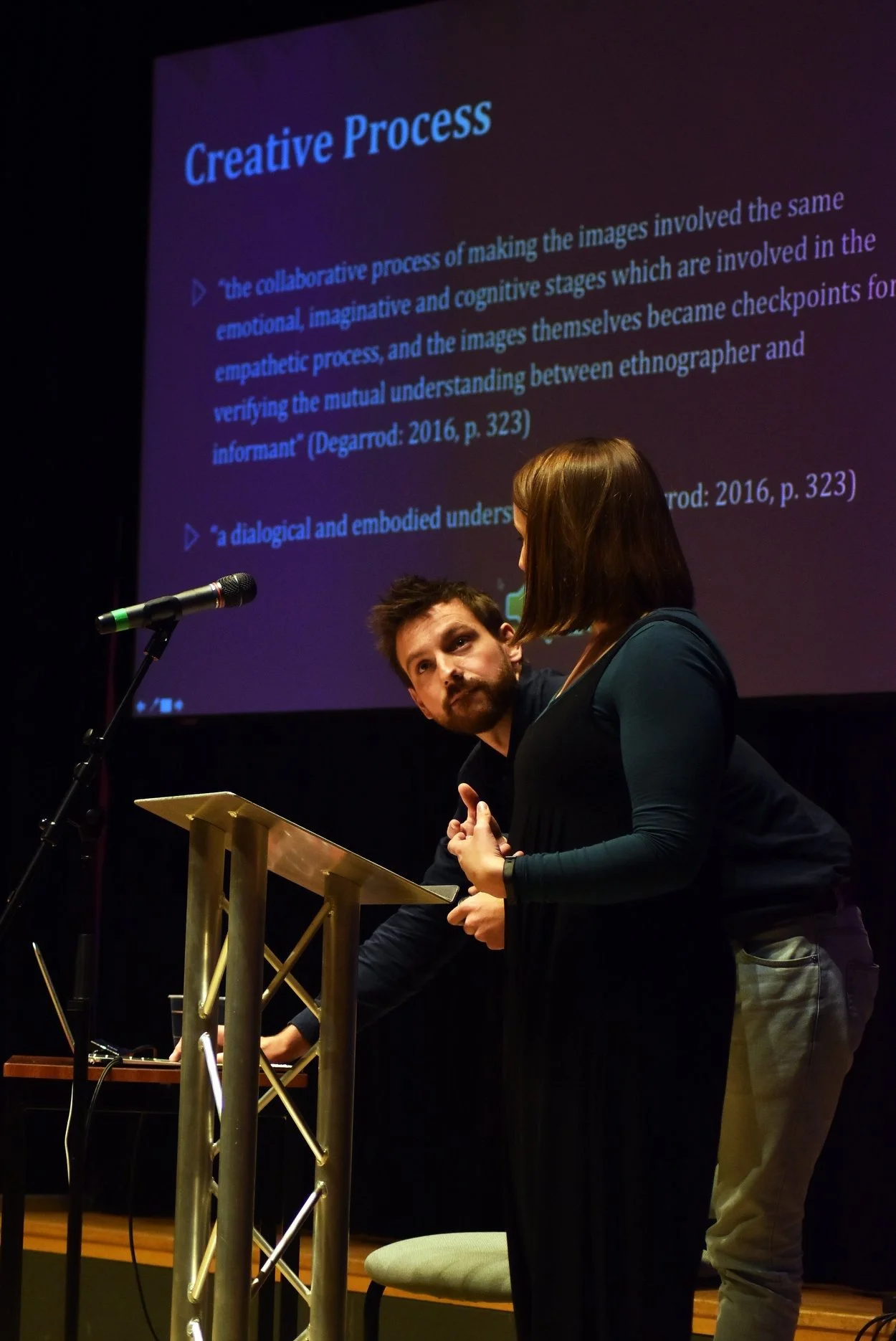
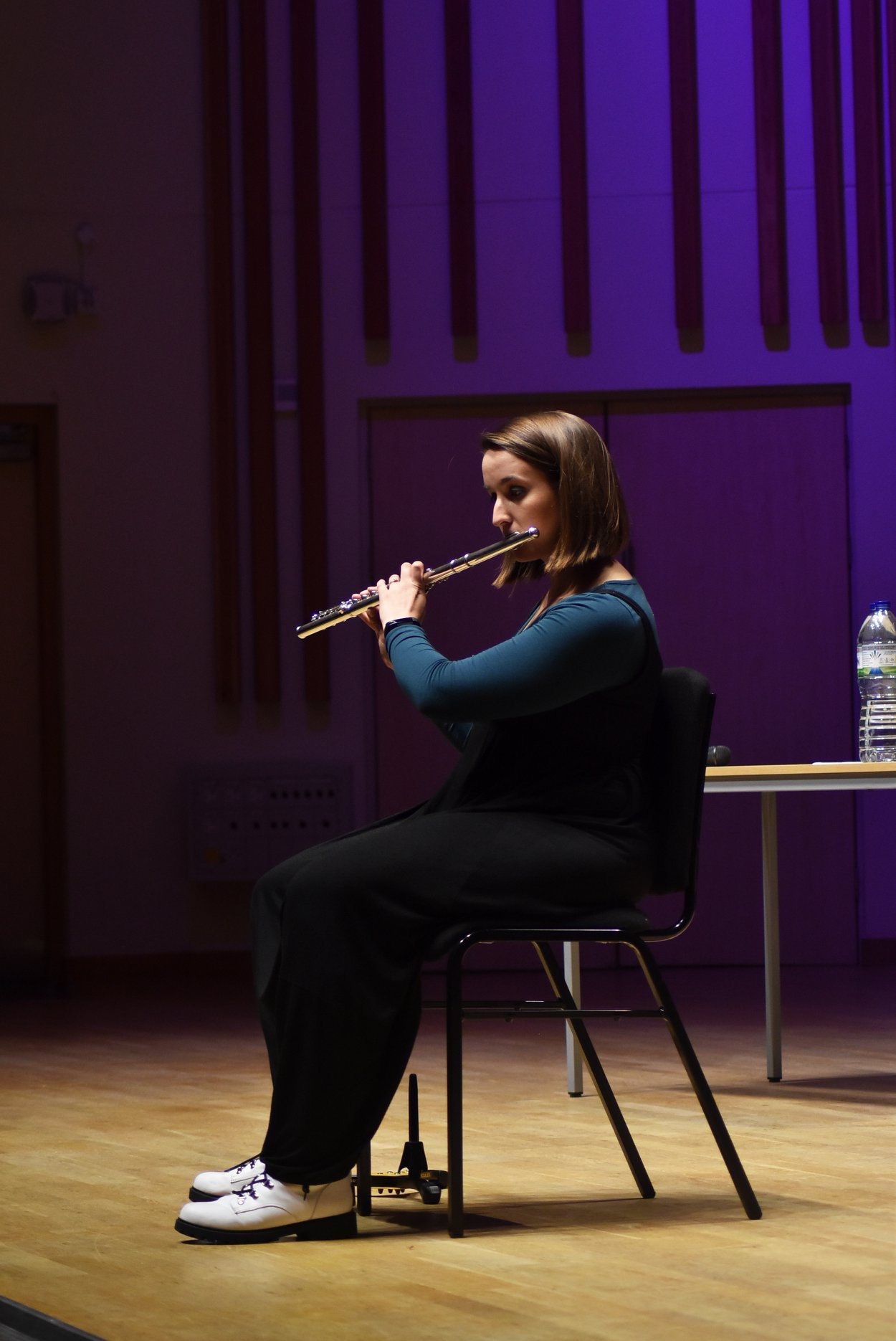
It was the first time within Coming Up for Air that I felt my story itself had become the subject of a piece, rather than the context surrounding the project. That could easily have become uncomfortable. Mark was working with extremely personal material: my illness, my recovery, my relationship with my instrument, and a piece of orchestral repertoire carrying years of professional and emotional baggage. What mattered enormously was what he did with the artistic authority he had. He stepped back.
Once we had made the soundtrack, Mark became increasingly conscious of the possibility of appropriating my experience for his own artistic purposes. Rather than continuing to add his own compositional voice, he allowed mine to become more prominent. My breathing, my words, my memories and my physical decisions became the material of the work.
In my PhD I identified this as a turning point in how I understood my own creative agency. I had entered the project thinking of myself primarily as performer and curator. Here, somebody else treating my experience and decisions as artistically authoritative helped me begin to recognise myself as a composer and creative author too.
There is something important in that for me now:
Sometimes professionalism means knowing how to lead. Sometimes it means sharing authority. Occasionally it means recognising that the most generous artistic act is to put less of yourself into the space. The piece became more mine because Mark did not need to make himself more visible within it.
Sometimes somebody lets you into their world
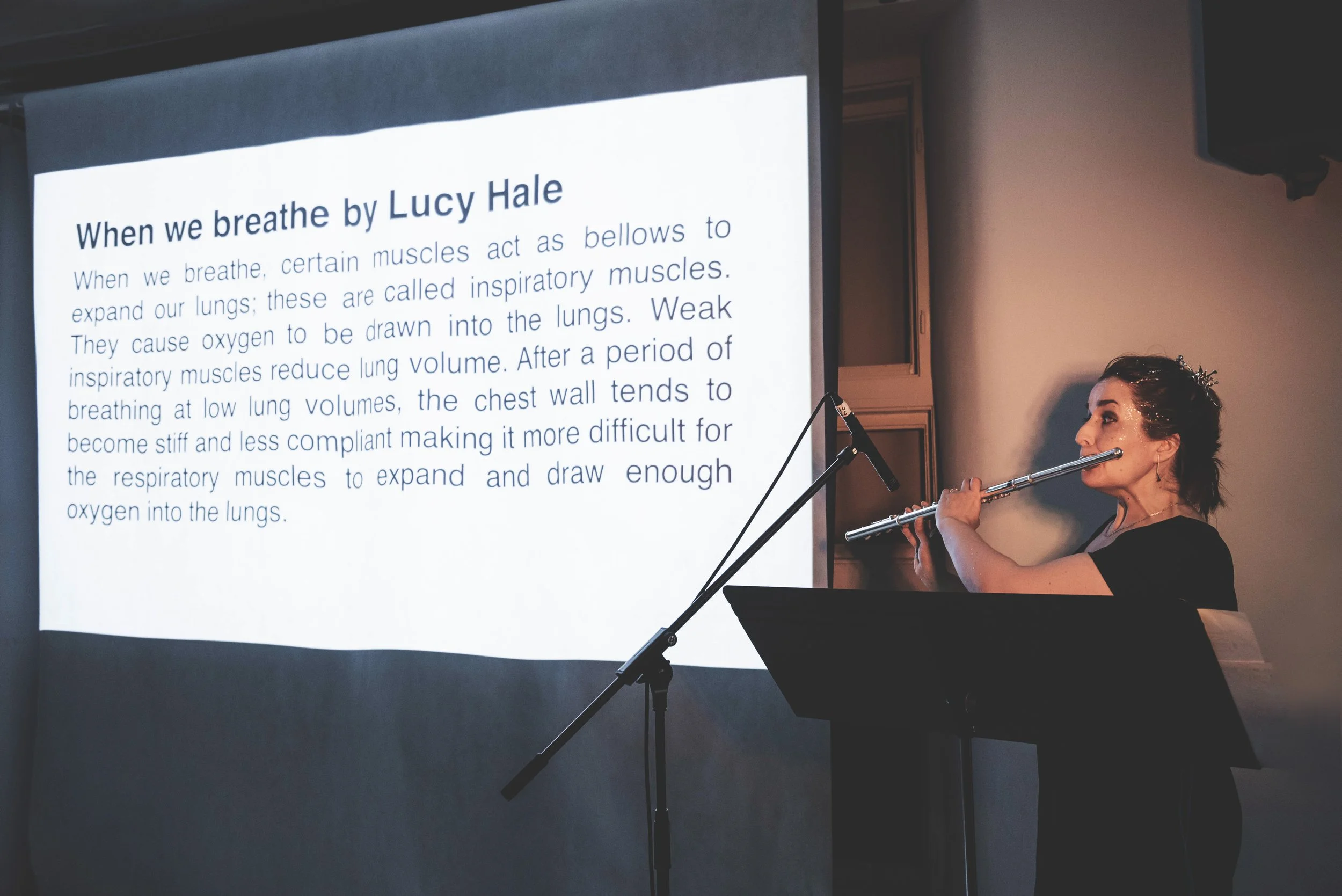
Performing When We Breathe by Lucy Hale at AzTak Festival. Photo by Marina Lewandowska.
Other collaborations reversed that relationship.
Megan Grace Beugger's Asthmatic Inhalation and Exhalation emerged from bodily recognition. We both knew asthma. Her piece mimics aspects of bronchial spasm, and performing it could provoke physical memories in me of my own breathing difficulties.
Lucy Hale's When we breathe was different. Lucy invited me towards an experience that wasn't mine.
When she responded to the Coming Up for Air brief, she was experiencing a period in which breathing had become particularly difficult and her speech increasingly interrupted by the need to breathe. She became interested in the difference between that stop-start spoken voice and what she described as her much more fluid internal or “thinking” voice.
She recorded herself reading information about respiratory problems in conditions like hers. Rather than translating that speech into conventional notation, we developed an audio-score version: I listened to Lucy's voice through an earpiece and suspended my own breath whenever she took hers, releasing only tiny amounts of air between the pauses.
The result lasts more than two minutes and is one of the most physically demanding pieces in the collection. But the difficulty wasn't only technical.
Lucy's spoken voice was something she generally reserved for people close to her. Being given access to it felt like entering an intensely privileged space. I was trying to respond musically to the physical effort in her speech without turning her disability into a performance of my own.
When I sent Lucy an early recording, she told me that she was struck by how effectively the sound captured something of the effort she was experiencing. I replied that playing it was really hard, but that what felt important was being “in it” with her: it felt as though she had invited me into the struggle, and having her voice in my ear felt like a privilege.
Around the same time, Lucy had been reading discussions about disability simulations: exercises in which non-disabled people are temporarily asked to approximate an impairment (using a wheelchair, for example, or completing a task blindfolded), supposedly in order to develop empathy.
Lucy was sceptical of what such exercises claim to offer. A temporary simulation can create the illusion that somebody now understands a disabled person's experience when, in reality, they have encountered only an artificial fragment of it. It can reduce a life to difficulty and limitation rather than communicating the knowledge, adaptations, relationships and history that come with actually living it.
That presented us with an obvious question: was When we breathe doing the same thing?
I was deliberately constricting my sound and placing my breathing under considerable strain in response to Lucy's speech. But I could not learn what it was like to inhabit Lucy's body by reproducing aspects of her breathing. Nor should that have been the goal.
Lucy made an important distinction in the blog she subsequently wrote about the piece. There was no pretence that performing When we breathe gave me an equivalent experience of her disability. Instead, she wondered whether art might offer something more indirect (and perhaps more meaningful) than simulation. An artwork made by a disabled artist could communicate something about lived experience while retaining all the abstraction, ambiguity and humanity that a generic training exercise strips away. That distinction still feels important to me.
For the duration of the piece I listened extraordinarily closely: to her breathing, her timing, the interruptions in her speech, and the physical traces of a body very different from mine. My own body responded to that encounter, but it did not become hers. There is something about collaboration here that extends well beyond this particular piece.
Empathy does not require equivalence. Empathy does not confer ownership.
Sometimes the most meaningful collaborative invitation is not: come and experience what I experience. It is: come close enough to pay attention.
That is something I want to carry consciously into future collaboration.
Sometimes access begins before the artwork is fixed
Other breaths taught me quieter lessons. Since my diagnosis, I have been thinking differently about access. It is often imagined as something that happens once the artwork has already been decided:
Here is the work. What adjustment will allow this person to execute it?
But access can exist much earlier.
What sort of structure allows this particular body and mind to contribute most interestingly?
Those are very different questions. The latter might change the artwork, and I increasingly think that is fine, perhaps even desirable.
A score that leaves room for bodily decision-making, a rehearsal process that allows somebody to return to a question tomorrow, a collaboration in which sensory or communication needs can alter how the work is made: these things aren't necessarily accommodations around the edges of artistic practice. They can become part of the creative method itself.
We do not enter rehearsal rooms as brains carrying scores. We bring nervous systems, bodies, histories, sensory environments, relationships, illnesses, hunger, caring responsibilities, exhaustion, enthusiasm, and whatever happened on the journey over.
Sometimes we have the capacity to hold all of that quietly. Sometimes some of it spills out. Sometimes reality changes the original concept. Good collaboration can hold space for that without becoming structureless. Too much structure and nobody can move. Too little and people can get hurt.
Sometimes I just need to get back in the bucket

Understanding my AuDHD means I want to become much more overt about what happens when capacity runs out. For this I have an unexpectedly helpful Star Trek: Deep Space Nine metaphor.
Odo is a Changeling. He can sustain his humanoid form for a finite period and then has to stop, return to his natural gelatinous state and regenerate in a bucket. It isn't lack of commitment. It isn't negotiable. He has reached the limit of what that form can sustain. That feels familiar.
Sometimes I can rehearse, travel, perform, improvise, problem-solve, socialise and talk excitedly for hours. Sometimes I can't follow my sat nav. Sometimes I cannot articulate what I need. Sometimes I need silence, darkness, written communication, solitude, or to leave before everybody else goes out for dinner. Sometimes I just need to get back in the bucket.
There is probably a whole other essay in the fact that Odo's socially recognisable form is also the one he cannot maintain indefinitely. Late diagnosis has made me much more interested not only in what someone is capable of, but what allows them to regenerate. Going forward, I want collaborators to know some things about me earlier. For example:
I process some interactions later.
Please tell me directly when something isn't working.
Written information helps.
My silence does not necessarily mean disengagement.
If I withdraw after something very intense, I may simply be recovering.
My capacity is variable.
If I ask what you meant, it is probably better to tell me than to leave me constructing possible interpretations of it overnight.
I’ll ask you: how do you work?
Professionalism includes repair (and knowing when you can’t fix it)
None of this makes collaboration painless: Brains clash. One person needs to resolve a problem now. Another will not understand their own response until tomorrow. One experiences silence as rejection. Another experiences continued attempts at conversation as pressure. One speaks through implication. Another only hears the literal words. Two people can care enormously about each other and the work and still get something wrong.
This is why I increasingly resist the idea of professionalism as a morality test. Not every uncomfortable collaboration contains a villain. Sometimes something happened between us that neither of us intended, and professionalism can mean being willing to return to it:
Something felt odd there. Can we work out what happened?
I didn't understand what you meant at the time.
I need some time to process this, but I am coming back.
I thought we had agreed something different. What did you understand?
But there is another reason processing time matters to me.
I have experienced collaborations in which my processing time was mistaken for consent. Personal material was incorporated explicitly into artwork before I had fully understood what I was being asked, worked out how I felt about it, or had the opportunity to decide whether I actually wanted it used. By the time I had processed what had happened, the decision had already been treated as made.
That has changed how I think about consent in creative work.
I can remain in a conversation, answer a question, smile, continue rehearsing, even sound enthusiastic, and still not have finished processing what is being proposed.
The absence of an immediate objection is not the same thing as meaningful consent.
For me, processing time is part of consent.
That matters particularly when collaboration involves autobiographical material, bodies, disability, trauma, sexuality, relationships, or anything else that becomes difficult to retrieve once it has entered the artwork.
Sometimes the question needs to remain open long enough for somebody to know what their answer actually is.
What made some of those ruptures particularly difficult was what happened afterwards. I could go round and round the interaction trying to locate the mistake in myself: What did I misunderstand? What did I do wrong? Was I too much? Too sensitive? Too difficult?
My sensitivity to perceived rejection could turn an already painful experience into an exhausting exercise in self-blame.
Late diagnosis has not given me a convenient explanation for every difficult collaboration, but it has given me a much better understanding of how I process interactions, why I may recognise discomfort or meaning later, and why perceived rejection can hit me so hard. That makes it easier to distinguish between something I need to take responsibility for, a misunderstanding that might be repaired, and something genuinely harmful that I do not need to turn into evidence that I am the problem.
And sometimes repair is not possible.
Repair requires more than one person being willing to revisit what happened. It requires recognition, accountability and enough mutual trust to make returning to the relationship safe and worthwhile.
There have been times when the healthiest thing I could do was not to repair the collaboration, but to step away from it, make sense of what happened on my own terms, and move forward without that person.
Professionalism does not require endless access to me, nor does compassion require me to re-enter every relationship that has caused harm.
Sometimes repair happens between people. Sometimes it happens elsewhere. And sometimes moving on is the repair.
A freelance culture in which reputations are often built through things nobody says aloud is especially unforgiving for people who find implicit intentions difficult to read. I don't think the solution is for neurodivergent musicians to become infinitely better at guessing. Perhaps all of us could become a little better at saying things - and a little better at leaving space for an answer to arrive.
Communion
As I ponder Coming Up for Air's tenth anniversary, I am excited by the possibility of looking through this enormous body of work again from different directions.
It began with a very simple question: what can happen in one breath? It turns out: rather a lot.
Ten years later, another question is emerging: what happens after the breath?
Some of the breaths simply end. Some leave behind a physical object. Some create a relationship. Some become something much larger than anybody intended.
And looking back through the additional lens of AuDHD, I think the collaborations that transformed me most often contained some combination of autonomy, curiosity, explicitness, trust, vulnerability, compatible ways of being, and permission for the reality of the people involved to change the work. They let us become more ourselves rather than less.
That is what I mean by communion. Not sameness. Not endless niceness. Not perfect agreement. Not necessarily friendship.
A sufficiently safe shared space in which attention can move between people.
Something I bring changes what you make. Something you do changes what I thought I wanted.
Neither of us entirely disappears into the other, but the artwork is different because we were both there. We breathed together and those molecules will be dancing in the universe forever. And sometimes a single breath becomes its own universe.
We are here to make art together. Isn't that just wonderful?

Coming Up for Air Concerto, Luxembourg Philharmonic. Photo by Alfonso Salgueiro.
Further reading
Autistica (UK Autism charity)
Craddock E. Navigating residual diagnostic categories: The lived experiences of women diagnosed with autism and ADHD in adulthood. Health (London). 2026 Mar;30(2):235-257. doi: 10.1177/13634593251336163. Epub 2025 Apr 21. PMID: 40258189; PMCID: PMC12923626.
Heather Roche Advice for Young Composers
Useful practical performer-facing advice on rehearsal etiquette, preparation, deadlines and communication.
Juliet Fraser Sharing the Spoils of a Shared Practice
An important influence on my doctoral thinking around shared practice, artistic agency, vulnerability, authorship and collaboration.
Juliet Fraser In the Thick of It
Further reflections on the mess, intimacy and complexity of collaborative creative practice.
Ben Lunn What We Need to Thrive: Improving Collaboration with Autistic Composers
A particularly useful contribution to thinking about communication, sensory environments and the conditions in which neurodivergent artists can do their best work.
Musicians’ Union Access Riders for Musicians
Practical guidance for communicating access needs in freelance musical work.
Kathryn Williams The Visibility of Breathing: Flute Performance Practice, Collaborative Composition, Performance Art, And Resilience. University of Huddersfield, 2021.
